Best Salicylic Acid Serum for Oily, Blemish-Prone Skin
Best Salicylic Acid Serum for Oily, Blemish-Prone Skin
How Aesthetikos Salicylic Acid Serum takes a more intelligent approach to excess oil, clogged pores, blemishes and post-acne marks
There is a familiar cycle that many people with oily and blemish-prone skin know all too well.
Your face feels oily, so you cleanse more aggressively.
A blemish appears, so you reach for something stronger.
Your skin begins to feel dry or irritated, yet somehow still looks oily.
The blemish eventually settles—but leaves behind a stubborn-looking mark.
So another product gets added.
Then another.
Before long, your skincare routine has become a collection of products fighting different symptoms of the same problem.
But perhaps oily, blemish-prone skin doesn't need a more aggressive routine.
Perhaps it needs a more intelligent one.
Because excess oil, clogged pores, blemishes, enlarged-looking pores, post-acne marks and skin-barrier discomfort don't necessarily exist in isolation. They can overlap, which means treating one concern while ignoring everything around it may create a frustrating cycle.
For those looking for a Salicylic Acid Serum for oily skin, the goal is not simply to remove oil, but to address clogged pores and blemishes while supporting overall skin comfort.
Instead of approaching blemish-prone skin through Salicylic Acid alone, its formulation combines 2.5% Salicylic Acid, 5% Niacinamide and 1.5% Glycinated Azelaic Acid, then surrounds these targeted actives with hydrating and soothing ingredients.
The objective?
Clear. Balance. Refine. Calm.
Not attack.
Understanding Oily & Blemish-Prone Skin
Sebum isn't the enemy.
It is an oily substance produced by sebaceous glands and forms part of the skin's natural protective environment.
The problem begins when excess sebum combines with dead skin cells and other material within the follicle, contributing to clogged pores.
This can create the environment in which comedones—what we commonly call blackheads and whiteheads—develop.
But there is another misconception worth addressing:
Oily skin doesn't automatically mean well-hydrated skin.
Oil and water are not the same thing.
Skin can produce noticeable amounts of sebum while simultaneously experiencing dehydration or barrier discomfort.
This explains why aggressively stripping oily skin can sometimes feel counterproductive. The immediate oil may disappear, but skin can be left tight, uncomfortable and irritated.
The better goal isn't:
Remove every trace of oil.
It is:
Help manage excess oil and congestion while respecting the skin around it.
That distinction changes the entire philosophy of blemish care.
Why Do Pores Become Clogged?
Your skin is constantly renewing itself.
Dead cells naturally shed from the surface, while sebaceous glands produce oil. When material accumulates inside a follicle instead of clearing normally, a plug can develop.
If that plug remains open at the surface, oxidation can create the dark appearance associated with a blackhead.
If the opening is closed, it may appear as a whitehead.
Inflammatory blemishes add another level of complexity.
This is why simply washing the face repeatedly isn't necessarily enough. A cleanser primarily works at and around the skin surface.
For persistent congestion, skincare often needs an ingredient capable of working more directly within the oily environment of clogged pores.
And that is where Salicylic Acid becomes particularly useful.
What Does Salicylic Acid Do for Oily, Acne-Prone Skin?
Salicylic Acid belongs to the beta-hydroxy acid—or BHA—family.
One of the characteristics that makes it particularly relevant to oily and blemish-prone skin is its lipophilic, or oil-compatible, nature.
Rather than functioning only as a surface exfoliant, Salicylic Acid can work within oil-rich areas of the follicle, helping loosen accumulated material and support clearer-looking pores.
That is why it has become such an established ingredient in skincare designed for:
clogged pores, blackheads, whiteheads, excess oil and blemish-prone skin.
But there is an important question:
What happens after you've unclogged the pore?
What about excess oil?
What about enlarged-looking pores?
What about the visible mark that remains after a blemish?
And what about irritation?
That is precisely where the formulation strategy of the Aesthetikos Salicylic Acid Serum becomes more interesting.
ONE SERUM. MULTIPLE BLEMISH CONCERNS.
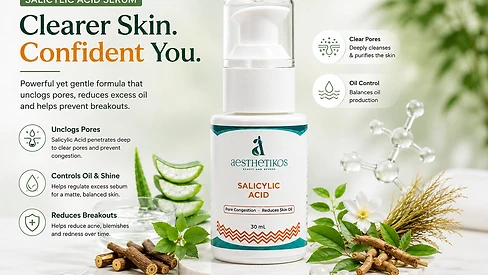
The Aesthetikos Salicylic Acid Serum combines 2.5% Salicylic Acid, 5% Niacinamide and 1.5% Glycinated Azelaic Acid
The thinking documented in the Aesthetikos formulation deck is refreshingly straightforward.
Many anti-acne products are aggressive towards the blemish—but can also be aggressive towards otherwise healthy skin.
And even when a blemish settles, the visible post-acne mark may remain.
Aesthetikos therefore designed its serum as a more complete system addressing several interconnected concerns within one formulation.
Let's unpack it.
ACTION 1 — CLEAR
2.5% Salicylic Acid: Help Clear Clogged Pores & Excess Oil
At the centre of the formula is 2.5% Salicylic Acid.
Its primary role in the Aesthetikos formulation is to help deeply cleanse clogged pores, manage excess oil and support blemish-prone skin.
Think about why that matters.
If congestion is developing inside an oil-rich follicular environment, simply making the surface of your face feel squeaky clean isn't addressing the entire problem.
Salicylic Acid gives the formulation its pore-focused exfoliating action.
This makes it particularly relevant for people concerned about:
BlackheadsWhiteheadsClogged poresExcess oilRecurring blemishesUneven skin texture
But Aesthetikos doesn't stop at exfoliation.
Because clearer pores are only one part of healthier-looking blemish-prone skin.
ACTION 2 — BALANCE & REFINE
5% Niacinamide: Because Oil Control and Skin Support Can Coexist
Niacinamide has become enormously popular in skincare—and with good reason.
In the Aesthetikos Salicylic Acid Serum, it is included at 5%, with the formulation deck specifically connecting it with the concern of enlarged-looking pores while balancing efficacy with tolerability.
That makes it a natural companion to Salicylic Acid.
Salicylic Acid addresses congestion.
Niacinamide broadens the routine towards oil balance, the appearance of pores and overall skin support.
This matters because blemish-prone skin isn't simply skin with spots.
People frequently experience a combination of shine + visible pores + uneven texture + blemishes.
Addressing these concerns together can make a formulation far more relevant to how people actually experience oily skin.
ACTION 3 — ADDRESS THE MARKS
1.5% Glycinated Azelaic Acid: Because the Blemish May Leave Before Its Mark Does
Anyone who has experienced recurring blemishes knows the frustration.
The breakout finally disappears.
But the evidence doesn't.
A visible red or brown mark can remain long after the original blemish has settled.
For many consumers, this becomes almost as frustrating as the blemish itself.
Aesthetikos specifically identified this problem while developing the serum and added 1.5% Glycinated Azelaic Acid to address the post-acne-mark component of the routine.
This changes the logic of the formulation.
Instead of:
blemish appears → use anti-acne serum → blemish settles → buy another serum for marks
the goal becomes a more integrated approach.
Congestion + oiliness + visible pores + post-blemish marks
within one formulation philosophy.
For a modern skincare routine, that's important.
People don't necessarily want more products.
They want products that are designed to think about their skin concern more completely.
ACTION 4 — CALM
Because Effective Blemish Care Shouldn't Mean Constant Irritation
This may be the most important—and most overlooked—part of the formula.
Salicylic Acid is an exfoliating active.
Aesthetikos therefore didn't design the serum as if the surrounding skin doesn't matter.
The formula includes a supporting complex of:
Aloe VeraHyaluronic AcidLicorice Root ExtractCucumber ExtractAshwagandhaGlycerin
These ingredients were incorporated specifically around the formulation's goal of making the Salicylic Acid experience gentler and more comfortable.
That reflects an important skincare principle:
More irritation doesn't automatically mean more efficacy.
Skin doesn't need to burn to prove that a product is working.
And excessive dryness isn't a badge of honour in an anti-acne routine.
A well-designed blemish serum should respect the skin surrounding the blemish too.
Why “Stronger” Isn't Always “Better”
Skincare has developed an unfortunate relationship with percentages.
Higher sounds better.
More actives sound better.
More tingling can somehow feel more effective.
But skin biology doesn't operate according to marketing bravado.
The best formulation isn't necessarily the one with the most aggressive concentration of a single ingredient.
It is the one in which ingredients have been selected to work together towards a defined skin objective while remaining appropriate for regular use.
This philosophy appears repeatedly throughout the Aesthetikos portfolio.
The brand positions itself around evidence-backed actives, transparent ingredient selection, safety, visible results and long-term skin health rather than trend-driven formulation.
The Salicylic Acid Serum is a particularly good example.
Instead of simply asking:
“How much Salicylic Acid can we put into this?”
the formulation asks a broader question:
“What does blemish-prone skin actually need?”
Clearer pores.
Oil management.
Better-looking pore appearance.
Support for post-acne marks.
Hydration.
Comfort.
That is a much more complete conversation.
What About the Skin Barrier?
The skin barrier deserves far more attention in conversations about oily and acne-prone skin.
Because people with blemishes frequently use multiple active products simultaneously:
an exfoliating cleanser in the morning,
an acne serum at night,
a scrub occasionally,
perhaps another acid,
maybe a drying spot treatment.
Individually, some of these products may have a legitimate role.
Collectively, however, an overly aggressive routine can become difficult for skin to tolerate.
That is why Aesthetikos' overall portfolio architecture places blemish treatment within a wider Cleanse → Treat → Hydrate → Protect philosophy rather than treating serum as the entire routine.
An oily-skin routine still needs thoughtful cleansing.
It still needs hydration.
And it absolutely still needs daytime sun protection.
Oil control should never mean abandoning skin health.
A Simple Routine for Oily & Blemish-Prone Skin
You don't necessarily need seven different acids and ten steps.
Start with consistency.
Morning
Gentle Cleanse → Appropriate Treatment → Moisturize → SPF
During the daytime, use a cleanser suited to your skin, follow with appropriate treatment products if your skin tolerates them, apply a lightweight moisturiser and finish with broad-spectrum sunscreen.
Evening
Cleanse → Aesthetikos Salicylic Acid Serum → Moisturize
After cleansing, apply the serum according to product directions and follow with a suitable moisturiser.
If you are new to exfoliating acids or have sensitive skin, introducing active products gradually is generally more sensible than immediately combining multiple exfoliating products.
And if you have persistent, severe, painful or cystic acne, skincare products shouldn't replace professional medical advice.
The Oily-Skin Paradox: Why Moisturizer Still Matters
One of the most persistent skincare myths is:
“My skin is oily, so I don't need moisturiser.”
But remember: sebum and hydration aren't identical.
A lightweight moisturiser can support hydration and skin-barrier comfort without necessarily making the skin feel excessively greasy.
This becomes especially important when using exfoliating actives such as Salicylic Acid.
The objective is balance.
Not dehydration.
A skincare routine that makes the skin feel painfully tight simply because it has successfully removed surface oil has misunderstood the assignment.
And Yes—Oily Skin Still Needs Sunscreen
There is another reason sun protection matters for blemish-prone skin.
Once a blemish subsides, visible post-inflammatory marks can become a significant concern, particularly in skin prone to pigmentation.
If uneven-looking post-acne marks are part of the concern, daytime photoprotection becomes an important part of the broader skincare strategy.
This fits neatly with Aesthetikos' architecture:
Treat the blemish. Support the skin. Protect the progress.
The brand's portfolio positions SPF50 PA+++ protection as the final Protect stage of its daily skincare ecosystem.
Frequently Asked Questions
Is Salicylic Acid good for oily skin?
Salicylic Acid is commonly used for oily and blemish-prone skin because of its ability to exfoliate and work within oil-rich clogged pores. The Aesthetikos formulation uses 2.5% Salicylic Acid as its primary pore-clearing and excess-oil active.
Does Salicylic Acid help blackheads?
Salicylic Acid is widely used in skincare designed for blackheads and clogged pores because its oil-compatible nature makes it particularly relevant to congestion within the follicle.
Can Salicylic Acid and Niacinamide be used together?
They can be formulated together. The Aesthetikos Salicylic Acid Serum itself combines 2.5% Salicylic Acid with 5% Niacinamide, with each ingredient serving a complementary role within the overall blemish-care formulation.
Does Aesthetikos Salicylic Acid Serum help post-acne marks?
The formulation contains 1.5% Glycinated Azelaic Acid, which Aesthetikos specifically incorporated into the product's strategy for marks left behind after blemishes.
Can oily skin be dehydrated?
Yes. Oily skin refers primarily to sebum production, while dehydration refers to insufficient water within the skin. The two can occur together.
Should I moisturize after Salicylic Acid Serum?
A moisturiser can be an important part of a routine using exfoliating actives because it supports hydration and skin-barrier comfort.
Can I use Salicylic Acid every day?
Frequency depends on formulation, individual tolerance and the directions supplied with the product. People new to exfoliating acids or with sensitive skin may need to introduce them more gradually.
Does Salicylic Acid make skin purge?
Some people may notice temporary changes after introducing exfoliating ingredients, but not every breakout should automatically be labelled “purging.” Persistent irritation, burning or worsening breakouts should not simply be ignored.
What is Salicylic Acid Serum used for?
Salicylic Acid Serum is commonly used in skincare routines for oily and blemish-prone skin to help address clogged pores, excess oil, blackheads, whiteheads and uneven-looking texture.
Is Salicylic Acid Serum good for oily skin?
Yes. Salicylic Acid is particularly relevant to oily skin because it is oil-compatible and can help address congestion within pores while supporting clearer-looking skin.
Is Salicylic Acid good for clogged pores?
Salicylic Acid is widely used for clogged pores because its oil-compatible nature allows it to work within the pore environment and help loosen accumulated material.
What should I use after Salicylic Acid Serum?
After Salicylic Acid Serum, follow with a suitable moisturizer to support hydration and skin-barrier comfort. During the day, finish with broad-spectrum sunscreen.
Stop Fighting Your Skin. Start Understanding It.
Oily and blemish-prone skin is often spoken about as though it needs discipline.
Strip the oil.
Dry the spot.
Scrub the pores.
Attack the acne.
But healthy skincare doesn't have to be adversarial.
Your sebum has a function.
Your skin barrier has a function.
Inflammation has consequences.
And the mark left after a blemish matters too.
That is what makes the formulation philosophy behind the Aesthetikos Salicylic Acid Serum compelling.
2.5% Salicylic Acid targets congestion and excess oil.
5% Niacinamide expands the approach towards enlarged-looking pores and skin support.
1.5% Glycinated Azelaic Acid addresses the post-blemish-mark dimension.
And Aloe Vera, Hyaluronic Acid, Licorice Root, Cucumber, Ashwagandha and Glycerin surround those actives with a more soothing, hydration-conscious formulation philosophy.
It is not about throwing the strongest possible active at a blemish.
It is about recognising that oily, blemish-prone skin needs more than one answer.
Clear the congestion. Balance the oil. Refine the appearance of pores. Address the marks. Respect the barrier.
Because clearer-looking skin isn't created by fighting your face every morning and night.
It begins when your skincare becomes as intelligent as the skin it is designed to care for.